
The complete guide to renovating a small apartment (45 to 70 sqm): planning, order of works, wet core
A small apartment doesn't forgive planning mistakes, because every meter and every workday is on show. This guide is a general map of the renovation: what to plan up front, what order to work in, where the wet core decides everything, and how to choose a crew that won't send you back to work.
Updated July 2026 · Nur Renovations
The short answer
To plan a small apartment renovation, plan the whole space on paper before you pick up a hammer, then work in a fixed order from rough to fine: demolition, plumbing and electrics, waterproofing the wet core with a flood test, then tiling and finishes. The wet core, the bathroom and the plumbing, is the heart of the job and gets most of the attention, because a failure there surfaces late and is expensive to fix. There's no single number; a real figure comes only after a site visit and a transparent BOQ that spells out what's included and what isn't.
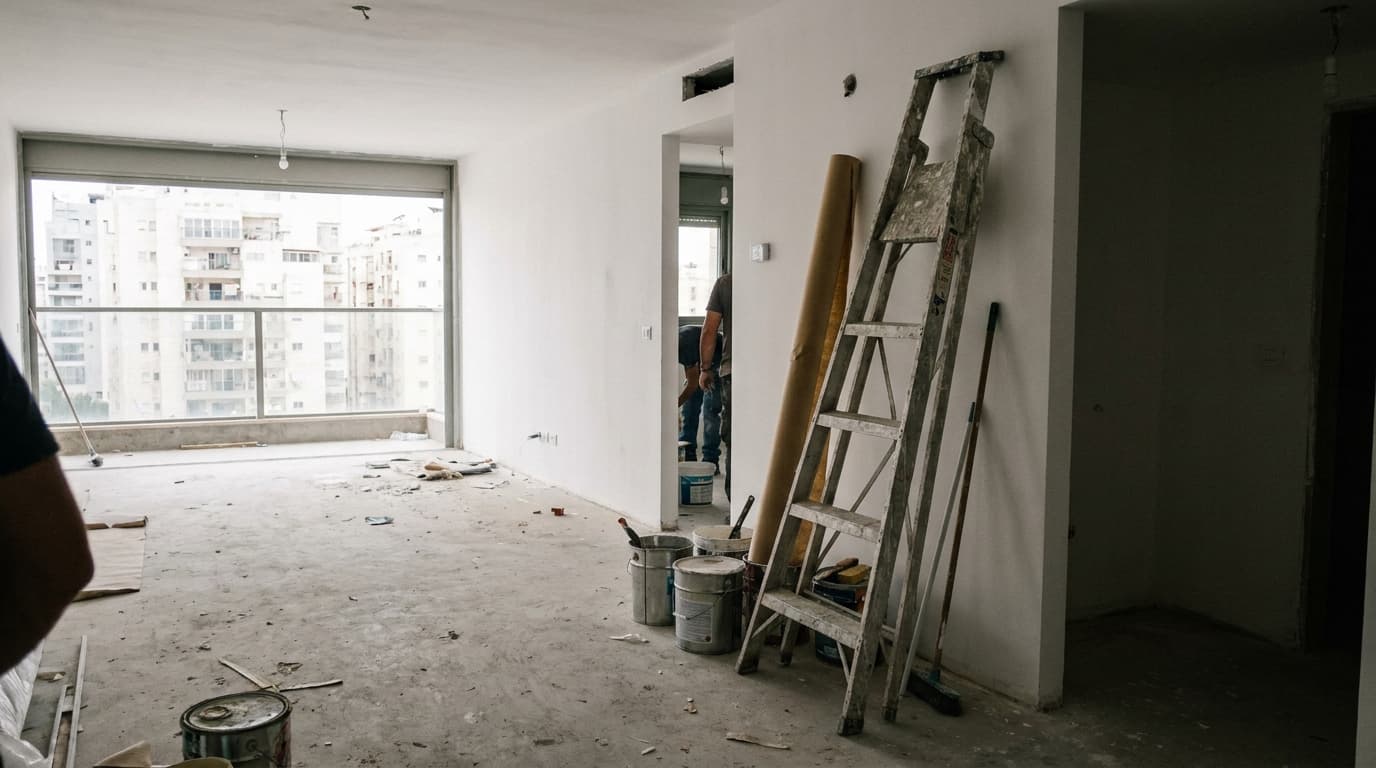
Renovating a small apartment, roughly 45 to 70 sqm, looks like a simpler project than a large house, but in practice it isn't more forgiving, it's less. In a large space you can hide a mistake behind a wall or in a corner. In a small apartment every meter is on show, every wrong pipe run eats into storage, and every workday that drags is felt, because you're living in the mess or paying for somewhere else to stay.
This guide is the general map. It doesn't go deep into every number and every stage, there are separate guides for that which we link to. Here you get the whole picture: what to decide before you pick up a hammer, what order the works run in, why the wet core is the heart of the whole renovation, and how to spot a crew that will get it right the first time.
We're a small, hands-on crew that works mostly on apartments in central Israel: Tel Aviv, Ramat Gan, Givatayim, Herzliya, Ra'anana, Kfar Saba and nearby. Our core is tiling, plumbing and waterproofed bathrooms. We work with a transparent BOQ, a fixed crew, a documented flood test and a written warranty on wet work. Everything here sits on that work in the field, not on theory.
01Plan the whole apartment before you start, not as you go
The most expensive decisions in a renovation are made before any work begins, even when they don't feel expensive at the time. The position of a water point, a power point, a wall you knock down, a door you move: each is cheap to change on paper and very expensive to change once the wall is closed. So in a small apartment the full plan is done first, across the whole space, not room by room on the move.
Start from how the apartment is actually used. How many people live there, where you cook, where you store things, whether you need a work corner, how many people use the bathroom in the morning. In a small apartment the answer is usually not to add walls but to remove them: opening a kitchen to the living room, merging two small spaces into one that works. Every such change affects plumbing and electrics, so it belongs to the planning, not the finish.
Before you start you also need to know who is responsible for what. In a shared residential building some works require coordination with the building committee or the neighbors, and changes to load-bearing walls or to common property are subject to the law and the building's bylaws. We go over this with you at the site visit, marking what needs approval and what doesn't, so you don't get stuck halfway.
Field tip
In a small apartment, plan the storage before the finish, not after. A recessed niche, a floor-to-ceiling cabinet, or a shelf set into the wall depth is decided at the structure and plumbing stage. Leave storage to the end and you're left with cabinets that stick out into a space that's already small.
02Order of works: why it decides things in a small apartment
A proper renovation moves from rough to fine, and from the bottom up. First demolition and strip-out, then hidden infrastructure, plumbing and electrics, and only then waterproofing, tiling, plaster, paint and finish. That order isn't arbitrary. Each stage covers the one before it, so a stage you skip or reverse forces you to reopen something that was already closed.
In a large house you can sometimes work on several rooms in parallel and absorb some disorder. In a small apartment there's no room to maneuver: one crew in one space, and a mistake in the order freezes the whole site. If you tile before finishing the plumbing in the adjoining wall, every later plumbing fix breaks new tile. So in a small apartment, the order is what separates a few-week renovation from one that drags out for months.
One fixed crew that carries this order end to end is worth far more than subcontractors who swap in and out. When the same people own the waterproofing, the tiling and the plumbing, there's no seam where one blames the other. We wrote out the full breakdown of each stage in a separate guide on the order of works.
- Demolition and strip-out: take down what's coming out, expose the existing infrastructure
- Infrastructure: plumbing and electrics in walls and floor, before anything is closed
- Wet core: waterproof the bathrooms and a documented flood test before tiling
- Tiling and cladding: floors and wet walls, after the waterproofing is tested
- Finish: plaster, paint, joinery, final electrics and sanitary fixtures
03The wet core: the heart of any apartment renovation
If there's one place in a small apartment worth most of the attention, it's the wet space: the bathroom and kitchen, and the plumbing that connects them. Almost all the risk in a renovation concentrates here. A waterproofing or plumbing failure doesn't stay local, it climbs into the next room, drops to the neighbor below, and surfaces months after you've already paid and closed the room.
A bathroom in a small apartment is usually the only one, so you have no backup while it's being fixed. That's why we treat it as the most critical work: a cove fillet at the wall-to-floor junction, waterproofing carried high enough up the wall in the spray zone, a correct connection of the waterproofing to the drain, and a documented flood test before tiling. Tile and grout are the finish over the waterproofing, not a substitute for it.
Plumbing is also a core, not an add-on. In a small apartment, every grouping of water points, or an accessible manifold, saves space and eases future maintenance. A hidden wall can hide a lot, but it can't be fixed easily, so it's better to do it right once. The breakdown of waterproofing failures and how to avoid them is in a separate guide worth reading before you start.
Watch out
Tiling before the waterproofing is checked with a flood test is the most expensive gamble in a small apartment renovation. If the waterproofing fails under the tile, the fix is tearing out a whole room, not a local patch. The flood test is the proof the waterproofing sealed, and it's worth asking to see documentation of it.
04Tiling and finishes: function first, aesthetics after
In a small apartment, tiling does more than look good, it sets how the space reads. A continuous floor in the same tone across the whole apartment, without a cut transition at every opening, makes it feel larger to the eye. Fewer grout lines also means fewer points that blacken and fewer places that can fail over time. Here function and looks pull in the same direction.
A large tile with fewer joints is usually a good choice for a small apartment, but it demands a flat, level floor, otherwise it highlights every wave. So the quality of the substrate preparation matters no less than the choice of tile. We work with a level and a laser so the surface stays flat across the whole space, and that's what separates tiling that looks good on day one from tiling that stays good for years.
On wet walls the same logic holds: cladding is first of all mechanical protection over the waterproofing, and only then a look. The choice of tones and design is yours, our job is for the base underneath to hold. The breakdown of tiling and cladding choices is on the floor and wall tiling page.
05Budget and timeline: where the money actually goes
In a small apartment the budget doesn't split evenly across every meter. Most of the money goes to the wet spaces: the bathroom and kitchen need plumbing, waterproofing, cladding and fixtures, and that's where cheap work comes back to bite. Dry spaces like the living room and bedroom are usually cheaper per meter, because they're mainly floor, plaster and paint. So a smart budget cut trims the dry finish before it touches the wet core.
We don't give a price off a phone call. A real number needs a site visit: to see the state of the infrastructure, the existing floor, the access to the apartment and what really needs to come out. After the visit you get a transparent BOQ that spells out what's included and what isn't, so there are no surprises midway. Any price range you find online is for orientation only, not a quote.
The timeline depends mainly on the scope of the wet core and the quality of the up-front planning. The more is decided in advance, the fewer mid-job stops. The full breakdown of cost components and ranges is in the separate budget guide, so we don't put a price list here that reads as a promise.
Field tip
The gap between two quotes almost always comes from what isn't written in them. A cheap quote that leaves out waterproofing, waste removal or substrate preparation isn't cheap, it's partial. A detailed BOQ is the only way to compare like for like.
06How to choose a crew for a small apartment renovation
In a small apartment the contact between whoever works and whoever lives there is very close, so the choice of crew matters no less than the planning. The search shouldn't be for the cheapest but for whoever gives a clear BOQ, whoever explains the order of works with logic, and whoever is willing to put a warranty in writing on the wet work, not just as a verbal promise.
A fixed crew beats a chain of swapping subcontractors. When the same people own the waterproofing, the plumbing and the tiling, there's no point where one points a finger at the other when a problem shows up. Ask who will work in the apartment, who's in charge on site, and what happens if damp appears after handover.
So you don't have to invent the questions yourself, we gathered the questions that genuinely reveal the difference between one crew and another in a separate guide. One good question at the first visit saves a lot of trouble later.
Planning a small apartment renovation? Let's start from the field
A visit to the apartment, a survey of the wet core and the infrastructure, and a transparent BOQ with a written warranty on wet work. No phone price and no surprises midway.
Site visit & quote