
Questions to ask a renovation contractor before you sign: a checklist
Most renovation horror stories don't start with bad work. They start with questions that were never asked before signing. These are the questions that separate a serious contractor from someone who vanishes the moment something asks him to come back.
Updated July 2026 · Nur Renovations
The short answer
Before you sign a renovation contract, ask for four things in writing: a detailed BOQ that itemizes every work item and material separately, a written warranty on the wet work (waterproofing, plumbing, bathrooms), a fixed crew that works together rather than rotating subcontractors, and a documented flood test that proves the waterproofing works before tiling. Ask too how the payment schedule is structured, milestones tied to work already done and checked rather than a big deposit up front. A serious contractor answers all of this in writing, and anyone who dodges it has already given you an answer.
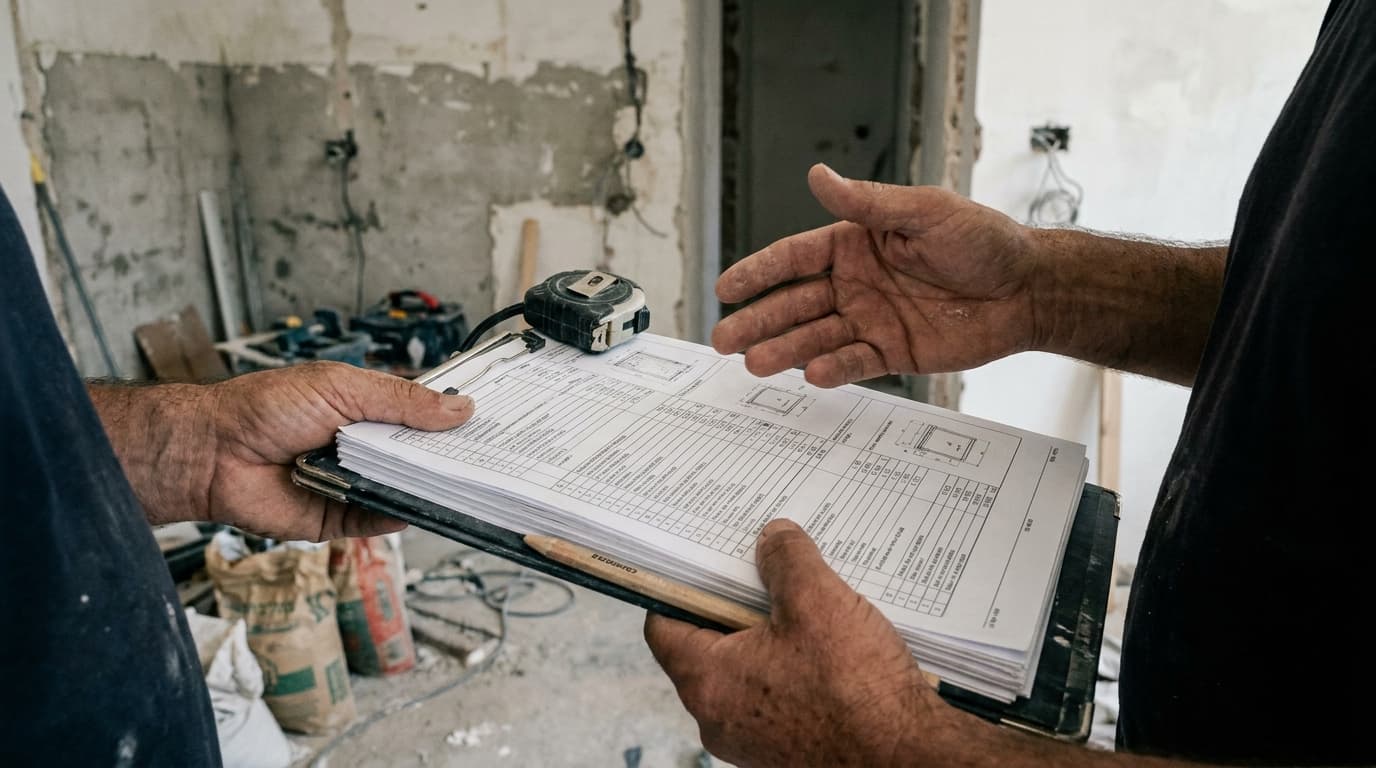
When choosing a renovation contractor, most people ask two questions: how much will it cost, and when will you finish. Both matter, but neither tells you whether the contractor will stand behind the work when damp shows up six months after handover, or whether the low price you got is actually a partial price that will swell halfway through.
The information gap here favors the contractor. He has done this hundreds of times, you once or twice in a lifetime. The way to close the gap isn't to haggle over the final number, it's to ask the questions that reveal how the contractor actually works: what the quote says, who shows up to work, what happens when something goes wrong, and who is responsible for what.
This checklist is built from the questions we'd want a client to ask us, because our answers to them are why clients stay calm through the project. Run through the list before you sign. A serious contractor will be glad to answer all of them in writing. Anyone who dodges them has already given you an answer.
01What is included in the price? Ask for a detailed BOQ
The first question isn't how much, it's for what. A one-line quote with a single large number isn't a quote, it's a trap. You can't tell what it includes, and you can't compare it to another quote. Ask for a bill of quantities (a BOQ): a breakdown of every work item and material separately, with the quantity and the unit price.
A detailed BOQ does two things. It shows you what you're buying, tiling by the meter, electrical points by count, waterproofing by area, and it blocks the most common trick in the trade: a low starting price that fills up with add-ons as the job runs. When everything is itemized up front, an addition is a clear overage you have to approve, not a surprise you discover on the invoice.
Ask what's not included too. An honest contractor tells you up front what falls outside the quote, special debris removal, structural reinforcement that only shows up once a wall is opened, material upgrades you asked for. A quote that leaves everything vague is designed to leave room for additions.
Field tip
When you compare two quotes, don't compare the bottom line. Compare line against line. A quote that's significantly cheaper is almost always missing something the pricier one included, and you'll pay the difference later.
02Is there a written warranty? What it covers and for how long
Every contractor will promise you verbally that the work will be excellent. The question is what happens when it isn't. A verbal warranty is worth as much as the person who gave it on the day you need it, and often he's no longer answering the phone. Ask for a written warranty, and ask to see what it covers.
The most important emphasis is on the wet work: waterproofing, plumbing, bathrooms. These are the jobs where a failure surfaces months after completion, under the tiles, somewhere you can't fix without tearing out. A written warranty on wet work isn't a legal document on its own, it's a statement from the contractor that he's confident enough in the work to commit to it on paper.
For us, the written warranty on wet work is a standing part of the engagement, and it rests on how we work: double waterproofing and a documented flood test before tiling. It's easy to give a warranty when you know the work was tested before you closed it up.
Watch out
A warranty that covers only the visible finish and not the substrate beneath it is nearly worthless. It's the hidden failures, in waterproofing and pipes, that are the most expensive and hardest to fix.
03Who will work in my home? A fixed crew or rotating subcontractors
The person who sells you the work isn't always the one who does it. With many contractors the actual work passes down a chain of subcontractors who rotate between stages, and sometimes between days. The result is that nobody sees the full picture, the plumber doesn't talk to the tiler, and a problem that falls between two trades is left orphaned.
Ask directly: who will be on site most days? Is it a fixed crew that works together, or people who rotate? A fixed crew knows your project from start to finish, carries information between stages without you having to relay it, and owns the work as a single unit. When something goes wrong, there's one address and not mutual blame.
Ask too who your point of contact is throughout the project. There should be one person you go to with any question, who knows the quote and the decisions already made. Without that, every morning starts with explaining it all over again.
04How do you verify the waterproofing works before closing it up? The flood test
This is an excellent test question, because it reveals whether the contractor understands wet work in depth or just performs it. Bathroom damp is the most expensive renovation fault to fix, because it surfaces long after the room is closed and forces you to tear out finished tile. The only way to prevent it is to prove the waterproofing works before you tile over it.
That proof is a flood test: you seal the drain, fill the wet area with water, and confirm there's no drop in the water level and no damp underneath or in the adjoining walls. Tiling starts only after the test passes. A contractor who skips this step saves a few hours now and rolls a year-from-now repeat renovation onto you.
Ask whether the test is documented. For us the flood test is a mandatory stage with documentation, a date and photos of the room flooded before tiling. That's the difference between waterproofing that was done and waterproofing that was also proven to work. For anyone who wants to go deeper, we have a separate guide on bathroom waterproofing failures.
Field tip
Listen to the answer. A contractor who explains fluently how he tests the waterproofing and what he documents works differently from one who stumbles or just says 'don't worry, we do it well'.
05How is the payment schedule structured? Milestones, not a big deposit
The payment structure tells you a lot about how the contractor works and about the balance of risk between you. The most worrying sign is a demand for a large payment up front, before a single day of work. A contractor who works properly doesn't need your money to start, and your money is your only security that the work gets finished.
Healthy payment is tied to milestones: a small amount at the start, then payments released as defined stages complete, demolition and prep, plumbing and waterproofing, tiling, finish. That way payment always follows work that's already been done and checked, and you're never far ahead of the contractor. Keep a meaningful final payment for the end, after handover and the snag list.
Ask how additions and overages are priced midway through. When everything rests on a detailed BOQ, an addition is a new item priced by the same logic, not an opportunity to set a fresh price once you're already in the middle and dependent on the contractor.
Watch out
The more a contractor wants more money earlier, the weaker his incentive to finish on time and to standard. Payment tied to real progress keeps both sides pulling the same way.
06How long will it take, and what happens when something goes wrong
Every contractor will give you a timeline. The more important question is what happens when it breaks, because in a renovation something nearly always surfaces: old pipework found when a wall is opened, unplanned reinforcement, delayed material supply. An experienced contractor won't promise you there'll be no surprises, he'll explain how he handles them when they arrive.
Ask the concrete questions: how many working days realistically, not best case. What happens if something not in the quote surfaces, how it's priced and who approves before work continues. How many hours the crew is actually on site each day. Vague answers here are usually a sign your project will get pushed aside every time another one comes up.
If it's a flat you're living in during the work, or a small-space renovation that needs to function again quickly, define that up front. A small-apartment renovation is run differently from a large project: less open time, more coordination with the life going on around it.
07Who cleans up, and what does handover look like
This question sounds small, but it reveals how the contractor sees the end of the job. With some contractors the last day is the day they collect payment and disappear, leaving you with building debris, dust over everything, and a few small defects nobody comes back to deal with.
Ask who is responsible for debris removal and cleanup at the end, and whether it's in the price or an extra. Ask what handover looks like: do you walk the space together, write a snag list, and set when the items get fixed. An orderly handover is what separates work that finished from work that was abandoned.
Finally, ask what happens if a problem surfaces after you've left. The combination of a written warranty, a fixed crew and a point of contact who stays available is what turns 'don't worry' into a promise you can enforce. Without it, the only answer you're left with after handover is hope.
- Debris removal and end-of-job cleanup: included in the price or a defined extra
- A joint handover with a written snag list and a date to address it
- A point of contact who stays available after handover, not just until the final invoice is paid
Want a quote that passes the checklist?
A site visit, a detailed transparent BOQ, and a written warranty on wet work. No starting price that swells halfway through, no surprises on the final invoice.
Site visit & quote