
How long does a small apartment renovation take? A week-by-week timeline
A small apartment renovation usually takes between five and eight weeks, but that number alone says little. What sets the pace is a chain of dependencies you can't compress: waterproofing drying, material lead times, and checks that have to pass before work continues. Here is a realistic week-by-week timeline, with the reason behind every wait.
Updated July 2026 · Nur Renovations
The short answer
A small apartment renovation of two to three rooms with one or two bathrooms usually takes five to eight weeks for full work that includes waterproofing and tiling. What stretches that range is the number of wet rooms, whether walls or plumbing get moved, and material lead times, and the bathroom is the pacing path because of waterproofing drying and a flood test you can't push. A precise timeline for your apartment is set only after a site visit and a transparent BOQ.
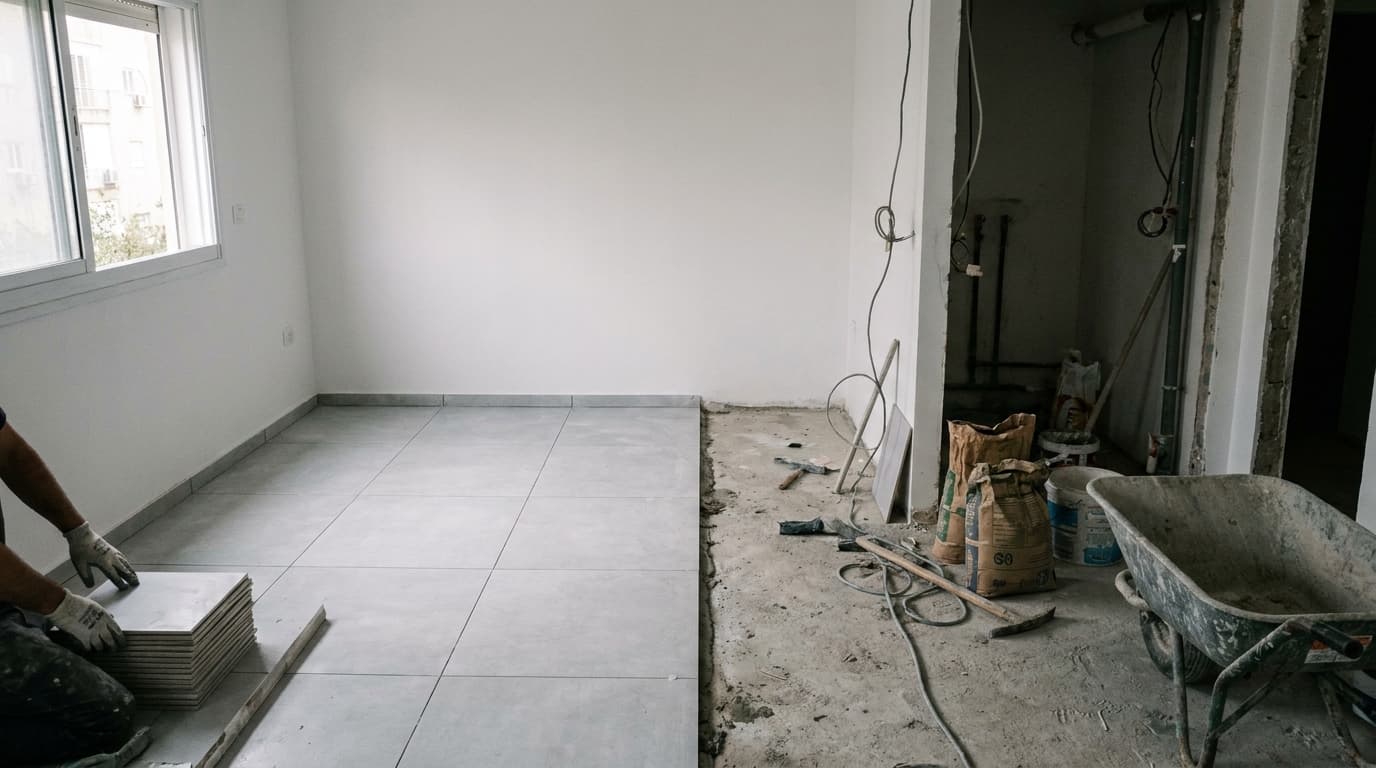
The first question almost every client asks is how long it will take. That's a fair question, because renovating an apartment you live in means life around dust, and sometimes a temporary move to another flat that costs money every week. But the honest answer isn't a single number. It's a timeline built from stages, some of which depend on each other and can't be shortened.
For a small apartment, say two to three rooms with one or two bathrooms, a reasonable range is five to eight weeks for a renovation that includes the wet work. What pushes the number up isn't the apartment's size alone, but how many wet rooms there are, whether walls or plumbing get moved, and how long the materials you chose take to arrive.
In this guide we break the timeline down week by week and explain the dependencies that actually set the pace. We won't get into the order of works itself here, which job comes before which and why. That has a separate guide. Here we talk about time: how long each stage takes, what it waits on, and why a fixed crew with a reliable schedule is worth more than a cheap price with a finish date that doesn't hold.
01What actually sets the renovation length
People tend to assume a bigger apartment means a longer renovation, but that's only part of the story. Two factors move the timeline far more than floor area: how much wet work there is, and how many infrastructure changes are involved. One extra bathroom adds days of waterproofing, drying and a flood test. Moving a wall or a plumbing point adds a whole stage of teardown and rebuild before finishing even starts.
The second factor is lead times. Tiles, fixtures, vanity units and special taps sometimes arrive within days and sometimes within weeks, depending on stock and whether they're imported. One item that arrives late can stall a whole stage, because you can't tile without the tiles and you can't fit fixtures before they've arrived. That's why orders are closed early, before work on site begins.
The third factor is what only shows up once you open things up. A wet wall, old pipework that needs replacing, or an uneven floor that surfaces after teardown. In older apartments this isn't unusual, and it's why a buffer is part of the plan rather than a sign something went wrong.
There's also a factor we'll call human: how fast decisions get made along the way. Even the best-coordinated crew stalls if a grout shade or a tap model is chosen in the middle of the stage that needs it. The more decisions are locked in advance, the smoother the pace on site.
Field tip
Before you ask for a finish date, ask how many wet rooms are involved and whether plumbing is being moved. Those two answers affect the renovation length more than anything else.
02Before week one: planning, measurements and orders
The on-site timeline only starts running after a stage where you see no workers: planning. Here we lock the exact scope, do a site visit and measurement, and prepare a detailed BOQ where every line is clear. The more thorough this stage is, the fewer surprises come later, and the fewer days are lost mid-project on decisions that could have been made upfront.
The critical part here is ordering. Every item with a long lead time, mainly tiles and fixtures, is ordered at this stage so it arrives before it's needed. We don't start tearing out before the critical items are on their way, because there's no point shutting down an apartment and then waiting two weeks for tiles that weren't ordered in time.
This stage usually takes a few days to a week and a half, depending on how fast your decisions come. It isn't part of the "weeks on site," but it determines whether they flow or stall.
03Week 1: teardown, clearing and rough infrastructure
The first week on site is the loudest and dirtiest. We tear out what's coming out, old tiles, fixtures, sometimes a wall that's being moved, and clear the debris. It's also the week the apartment reveals its secrets, so this is where surprises come up if there are any.
Right after teardown we move to the rough work: water and sewage plumbing changes, new electrical points, and any change to partitions. These have to be finished before walls and floors are closed, because access to them gets blocked afterward. In a small apartment with one bathroom, this stage usually fits inside a week. Another wet room or a significant plumbing move can stretch it to a week and a half.
Watch out
If old pipework or existing damp shows up during teardown, it's better to deal with it now even if it adds days. Closing a new wall over it means coming back to the same spot in a year.
04Week 2: waterproofing, and a wait you can't push
Here comes the dependency that surprises most people. Once the plumbing is in place, the wet rooms are waterproofed. But waterproofing doesn't end the moment it's applied. It has to dry for the time the manufacturer specifies before work can continue, and that time can't be shortened without risking the whole job.
After the waterproofing has properly dried comes the flood test: the wet area is filled with water and checked for no drop in level and no damp underneath or in adjoining walls. Tiling starts only after the test passes. This test is why a bathroom can't be "sped up": it's the only proof the waterproofing works before it's closed for good under the tiles.
The combination of drying and testing means a bathroom is usually the pacing path for the whole renovation. While the waterproofing dries, a good crew doesn't sit idle. It progresses on dry work in other rooms, so the wait doesn't waste days.
Field tip
A fixed crew plans the days around the waterproofing drying and works in parallel in dry rooms. That keeps the necessary wait from turning into idle days.
05Weeks 3 to 4: tiling, cladding and rough finishing
Once the flood test has passed, tiling and cladding begin. This is one of the longer stages, because it's manual and precise: leveling with a laser, cutting around corners and points, and keeping grout lines continuous. In a small apartment, tiling and cladding usually take a week to a week and a half, depending on the area, the tile type and the number of rooms.
Tiling has its own wait too. After the tiles are set, the adhesive has to dry before the joints are grouted, and after grouting more drying time is needed before you walk on and load the floor. Large-format tile or thin porcelain needs slower, more precise leveling, and that adds hours people don't always account for. In parallel we move ahead on prepping walls for paint, fitting door frames, and any dry work that doesn't depend on the wet floor.
06Weeks 5 to 6: finishes, installations and fixtures
This is the stage where the apartment starts to look finished. We paint, install fixtures and taps, connect electrical and lighting points, fit vanity units and the shower enclosure, and complete carpentry if there is any. All of these depend on the materials having actually arrived, which is when the early orders from week one pay off.
It's also the stage where one missing item hurts most. If a particular tap or shower door hasn't arrived, you can finish almost everything and still be left with a room you can't hand over. That's why we track deliveries the whole way through, not just at the start. When an item slips at the supplier, it's better to know in week two than in the week you're meant to install it.
07Handover, and why we always keep a buffer
The last week is cleaning, a small snag list, and a joint walkthrough of the apartment before handover. Here we close any missing grout, fix a scratch in the paint, adjust a cabinet door. Small things, but they're the difference between an "almost finished" apartment and one you can move back into.
A buffer of a few days to a week is part of the plan, not a sign of failure. In older apartments something almost always surfaces: an uneven floor, pipework that needs replacing, a wall that needs straightening. A crew that plans with no margin is forced to choose between pushing the whole schedule back and shortening stages that must not be shortened, like waterproofing drying. We'd rather give a finish date with a built-in buffer and meet it, than give an optimistic date that won't hold.
A reliable schedule isn't just courtesy. It's a direct result of a fixed crew that knows the work stages, coordinates between the trades, and knows when to order materials so no holes open up in the schedule. Our transparent BOQ lays the stages out in advance, and a site visit is what lets us give a realistic timeline for your specific apartment.
- How many wet rooms there are, and how many flood tests have to pass
- Whether walls, plumbing or electrical points are being moved
- The lead times of the tiles and fixtures you chose
- The state of the infrastructure that surfaces after teardown in an older apartment
Want a realistic timeline for your apartment?
A site visit, a transparent BOQ with clear stages, and a finish date with a built-in buffer you can count on. A fixed crew that plans the work so no holes open up in the schedule.
Site visit & quote