
Mamad renovation: what to verify before any change
A mamad is a protective system, so even a change that looks cosmetic must be checked for the specific room and component. This is a conservative checklist, not approval to proceed.
Updated July 2026 · Nur Renovations
The short answer
Do not infer from this site that any mamad change is permitted. Check current Home Front Command guidance, identify the authority actually responsible for the planned work, and verify the plan with a qualified engineer or installer as appropriate. This guide gives no approval, drilling depths, methods or material specifications.
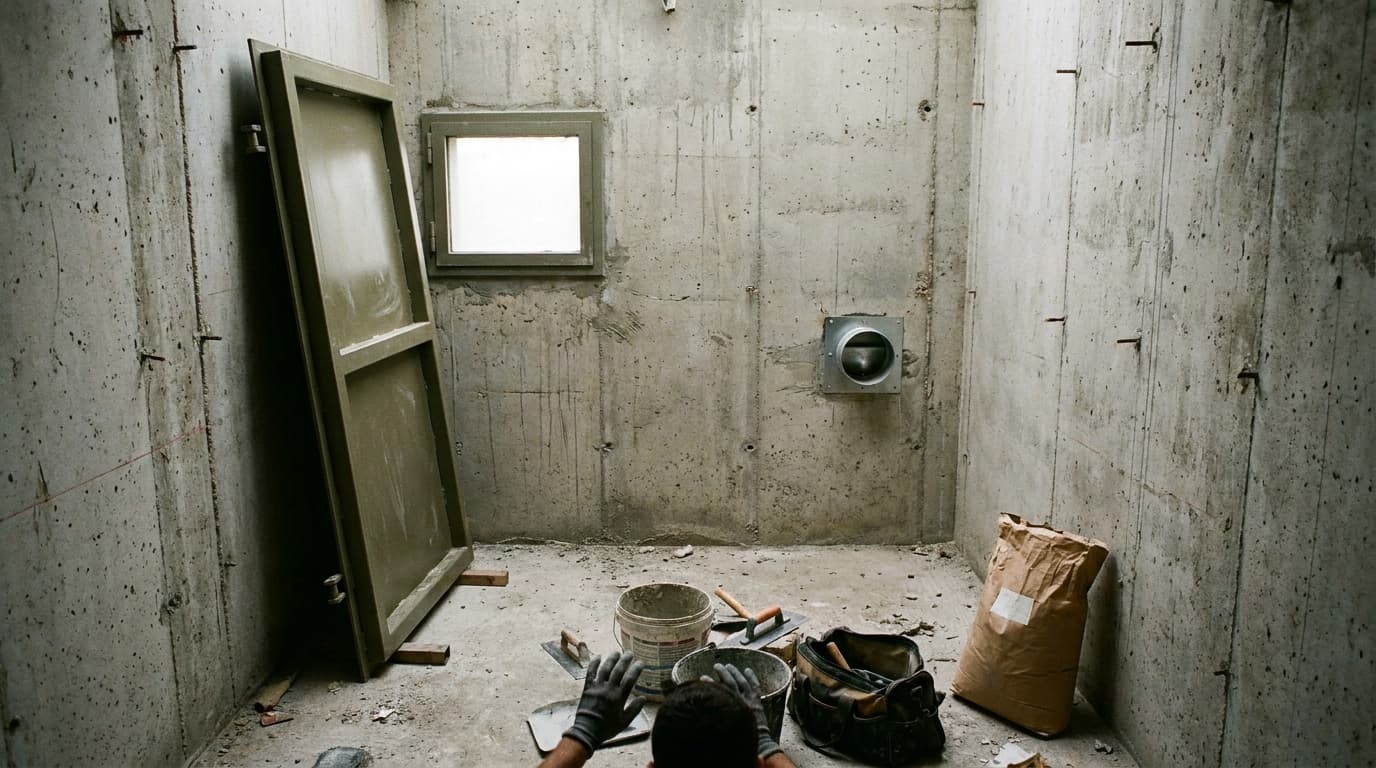
Many people treat a mamad like any other room in the flat: a storeroom, a study, a child's bedroom. That really is its job most of the year, so wanting it to look good and feel pleasant makes sense. The catch is that a mamad was built first as a protected room, and it has parts whose job is to hold pressure and stay sealed at the moment they're needed, even if the rest of the year they look like just part of the wall.
For mamad work, do not rely on a contractor website's rule of thumb. Check current official guidance, identify the authority relevant to the work, and verify the plan with a qualified engineer or installer.
This guide does not state what may be drilled, at what depth, by which method or with which materials. Requirements may vary with the room and current guidance.
01Why a mamad isn't just another room
A mamad, a residential protected room, is built as a sealed cell inside the flat. Its walls, ceiling and floor are reinforced concrete thicker than usual, the door and window are designed to close airtight against blast and against material entry, and it has a ventilation opening with a filtration system. All of these parts work together as one system. Harm one of them and you weaken the room's ability to function when it's needed.
The fundamental difference from an ordinary room is that a fault won't show up day to day. You can live for years with a mamad that was damaged in an earlier renovation without knowing it, because it keeps serving as a normal room. The problem only surfaces when you actually try to seal it, and that is the moment you can't fix it. So every decision in a mamad is measured not only by how it looks, but by whether it leaves the system intact.
Watch out
A mamad renovated incorrectly can look perfect and serve as a normal room for years, and still not seal when it has to. That is why caution in a mamad renovation isn't a formality, it's the one difference that actually matters.
02Finishes to consider — only after verification
Tiling, paint, cladding, lighting and furniture are topics to check, not approved methods. Check current guidance and verify the plan with the relevant authority and a qualified engineer or installer.
Even a finish that looks cosmetic needs review. Do not proceed from a general description; check current guidance and verify with the relevant authority and qualified professional.
- Floor and tiling work: case-specific review before execution
- Paint and cladding: case-specific review before execution
- Lighting and electrical work: review with a qualified electrician and relevant authority
- Furniture and shelves: review with a qualified engineer or installer
03Components not to change before specific approval
Doors, windows, openings, ventilation and filtration systems, walls and penetrations require a component-specific check before any change, removal, covering or drilling.
This site does not approve an action on those components or replace a specification. Check Home Front Command guidance and the requirements of the relevant authority and a qualified engineer or installer.
- Door and window: check any change with the relevant authority
- Ventilation and filtration: check any change with the relevant authority
- Walls and openings: this guide provides no specification or approval
- Pipe and electrical penetrations: plan with qualified professionals and the relevant authority
Watch out
This guide publishes no opening or drilling specification. Check current guidance and verify the plan with the relevant authority and a qualified engineer before any work.
04The door, window and openings: the most sensitive parts
Treat the door, window and seals as protective components. Check current guidance and the requirements of the relevant authority and a qualified installer before maintenance, removal or replacement.
Any finish near a door or window needs a detail reviewed in advance; this guide gives no clearance or installation method.
If a component squeaks, sticks or does not close, document the fault and check the current official route and qualified specialist before work.
05Checks before tiling or cladding
Before tiling, check current guidance and verify the complete plan with the relevant authority and a qualified engineer or installer. This guide approves no installation method.
Wall cladding requires a case-specific review of the complete plan. This guide recommends no material or fixing method, including methods without drilling.
Even a method without drilling is not automatically approved. Check the complete plan against current guidance and with the relevant authority and qualified professional.
Field tip
This guide gives no tiling, cladding or fixing method. Check current guidance and verify the plan with the relevant authority and a qualified engineer or installer.
06Drilling, electrics and hanging things on the wall
A cabinet, shelf or TV requires a case-specific review. This guide publishes no drilling depth, diameter, zone or fixing method; check current guidance and verify with the relevant authority and a qualified engineer or installer.
From our side in the field, the practical rule is to plan in advance how many hanging points you need and not improvise dozens of holes as you go. The fewer penetrations into the wall, the simpler it is to work within the guidance and keep the wall intact.
For electrical and data work, check every change with a qualified electrician, current guidance and the relevant authority; this guide does not decide that an existing or new point may be changed.
07The rule that sums it all up: verify before you cut
The takeaway is to check current guidance, identify the relevant authority and verify the plan with a qualified engineer or installer before work.
A BOQ can record questions and checks, but it is not approval to execute.
When you're renovating a small flat and the mamad is the study or the child's room, this combination matters all the more. You want a room that feels like a natural part of the home, without giving up what sets it apart from any other room.
Official sources
Renovating a mamad? Start with current guidance
A visit can document the condition and questions. Before execution, check Home Front Command guidance, identify the relevant authority and verify the plan with a qualified professional.
Site visit & quote