
Damp after renovation: diagnosis, contract and written warranty
When damp appears, first locate the source, preserve evidence and check the contract and warranty. Who bears the repair cost depends on the facts, agreement and law; seek legal advice if disputed.
Updated July 2026 · Nur Renovations
The short answer
Responsibility cannot be decided only from where the stain appears or who worked there last. Locate the entry point, document the findings, and check the contract, BOQ and warranty terms. Responsibility and cost depend on the work, each party's commitments, the facts and applicable law; if disputed, consult the appropriate professional and a lawyer. The Sale (Apartments) Law mainly concerns the sale of a new apartment, so do not automatically import its periods or evidentiary rules into a private renovation.
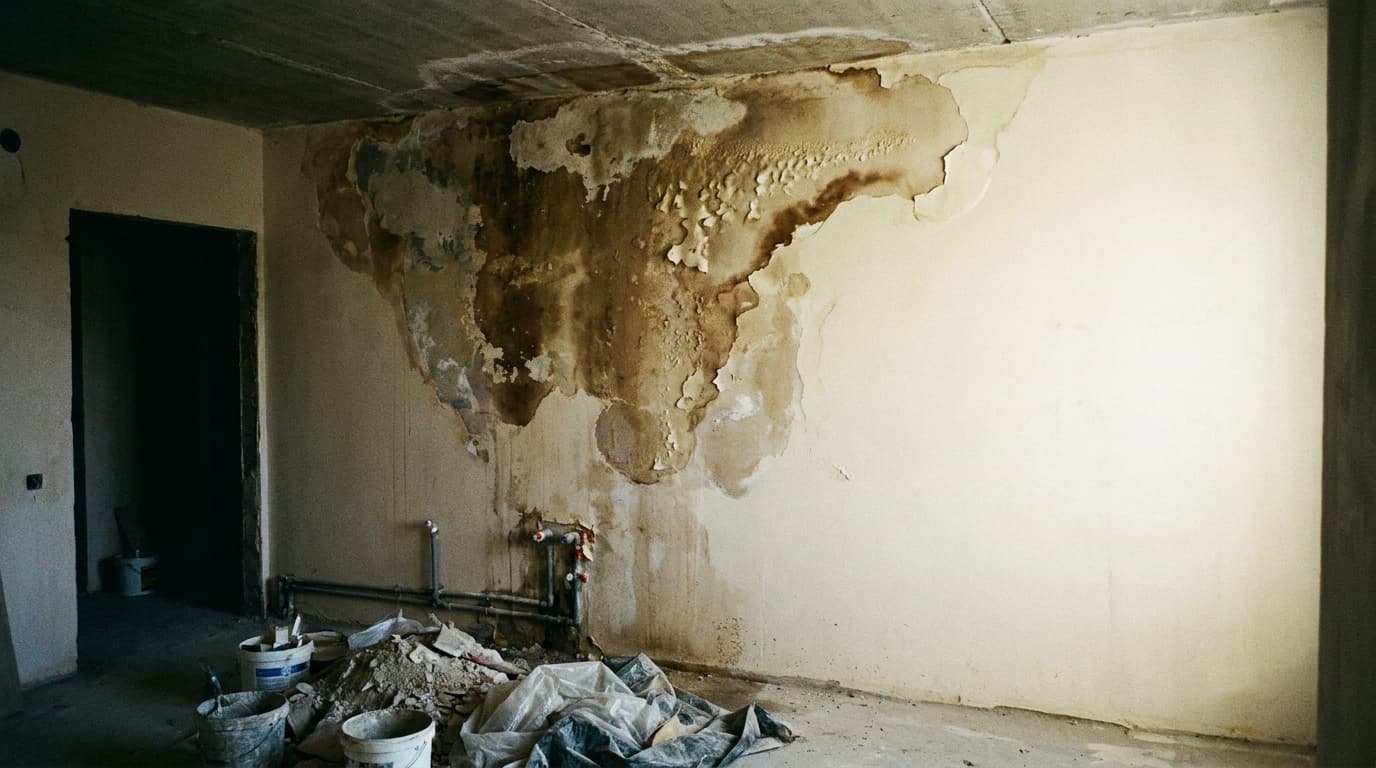
Damp almost never shows up the day the room is handed over. It returns months later: a stain on the neighbor's ceiling below, grout that blackens, a musty smell that won't clear. Then comes the real question, who is responsible for it, and who pays for the tear-out and the repair.
The answer depends on the source of the failure, the scope of work, what was promised and performed, the warranty terms and applicable law. Start with diagnosis and documentation; only then assess who may bear responsibility and cost.
This guide explains how to gather the facts and what to put in a written warranty. It does not determine legal rights; a real dispute calls for professional evidence and may require legal advice.
01Who is responsible for damp after a renovation
If diagnosis points to waterproofing or plumbing performed in the renovation, that is important evidence when responsibility is assessed, but not an automatic legal conclusion. Also review the contract, scope, warranty terms, later use and external factors.
Other possible sources include old pipework, a shared building system, an adjacent flat or the external envelope. Professional diagnosis and documentation help avoid assigning responsibility to the wrong party.
In gray areas, such as old pipework that was not replaced, the engagement documents and facts matter but may not decide the issue alone. If the parties disagree, obtain professional evidence and legal advice.
Field tip
Before you start blaming anyone, it's worth locating the source of the damp. A ceiling stain doesn't always come straight from the room above it. Water travels along pipes and layers, and can surface some distance from its source.
02What the inspection period is, and how it differs from warranty
Inspection and warranty terminology appears in different legal and contractual contexts. The Sale (Apartments) Law mainly concerns a seller and buyer of a new apartment; do not assume its periods or presumptions apply in the same way to a private renovation.
For a private renovation, review the contract, BOQ, warranty document, facts and applicable law. There is no general rule here that the burden of proof flips on a fixed date.
State the warranty period, covered work, exclusions, notification process and inspection process explicitly. If the parties dispute which law applies or who must prove what, seek legal advice.
Watch out
Do not import periods or evidentiary rules from a new-home purchase into a private renovation. Review the agreement and applicable law with a lawyer if a dispute arises.
03What the sale law says, and who it applies to
The Sale (Apartments) Law mainly concerns the sale of a new apartment by a seller. Damp alone is not enough to decide here that the law applies, who is responsible or which period is relevant.
For a renovation of an existing flat, consider the parties, type of engagement, contract, work performed and applicable law. Even a detailed contract may not be the only legal source.
The practical conclusion is to document rather than assume: keep the records, obtain a diagnosis, and seek legal advice when rights or payment are disputed.
04Why a written warranty is worth more than a verbal promise
A verbal promise is worth as much as you can enforce it, and when damp arrives a year after handover, it's hard to enforce something nobody wrote down. A written warranty turns the promise into a document: it says who is responsible, for what, and for how long, and whoever signs it knows they'll be held to it.
A written warranty should match the agreed work and state the scope, period, exclusions, notification process and inspection process. Records of the work stages and tests actually performed help assess a later incident.
If damp appears, follow the written process: notify, diagnose and document. Who repairs or pays is determined from the findings, agreement and law, not from a general marketing promise.
- Who is responsible and for which works, named explicitly (waterproofing, plumbing, tiling)
- How long the warranty applies, and what it covers and what it doesn't
- Documentation of the flood test: a date and photos of the room flooded before tiling
- A BOQ showing what was done, so you can know what the agreement was
05What to keep so you can claim the warranty without a headache
When everything works, nobody thinks about paperwork. The moment damp appears, the paperwork is what decides how fast and how smoothly the problem gets fixed. Keeping a few things in order in advance saves months of back-and-forth later.
Keep the contract, BOQ, warranty document and records of the work and tests actually performed. These documents help establish facts but do not by themselves prove who is responsible or who must pay.
If damp appears, don't wait. The longer you wait, the more the damage to the substrate and neighboring spaces grows, and the harder it gets to prove the link between the defect and the original work. Document the stain in a dated photo, and approach the contractor as early as possible.
Field tip
Dated records of the condition and tests actually performed may assist in a dispute, but their weight depends on the circumstances and professional evidence.
06First locate the source, then talk about responsibility
Damp may come from waterproofing, pipework, sewage, an adjacent flat or the external envelope. Locating the source matters, but does not by itself decide legal responsibility or payment.
Diagnosis starts by locating and documenting the entry point and carrying out appropriate tests. Then assess the findings alongside the agreement and law; obtain professional evidence and legal advice if disputed.
A sensible sequence is a site visit, diagnosis and documentation, followed by a written repair proposal. If the source, responsibility or cost is disputed, obtain professional evidence and legal advice where needed.
Official sources
Damp after a renovation? Let's find the source
A site visit, a diagnosis of the entry point, and a transparent BOQ with a written warranty on wet work. First we understand where the water comes from, then we fix it properly.
Site visit & quote